GLOBAL PULSE
BY: KARDEX Editorial on April 7, 2026
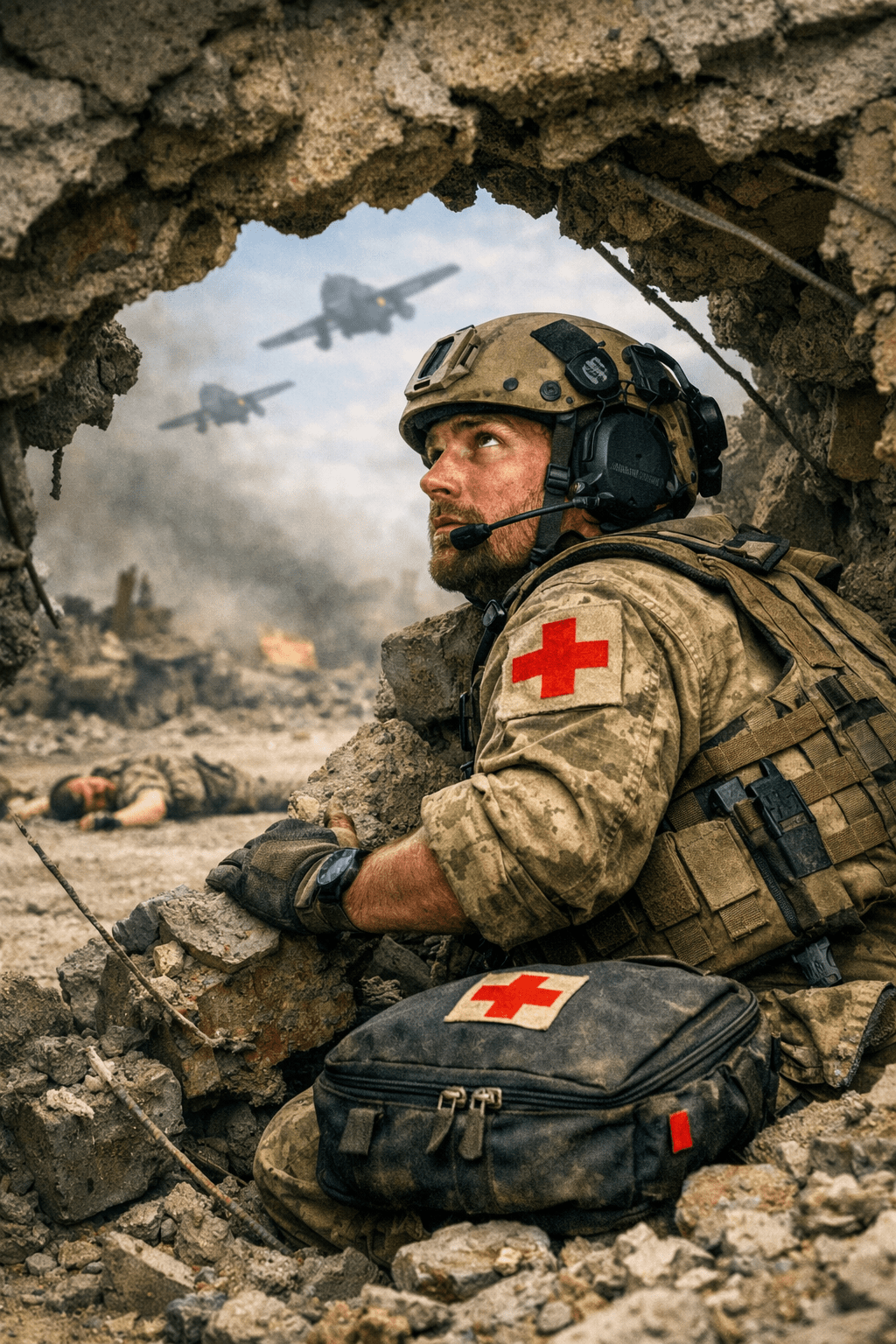
Some wars change borders; others change systems. What is happening in Ukraine is doing something more fundamental: it is changing the conditions under which the wounded can be saved. For the first time in decades, modern military medicine is being forced to operate without the one advantage it has come to depend on—time.
The Vanishing “Golden Hour”
For years, military medical systems were built on early extrication and the so‑called “Golden Hour.” First articulated by R. Adams Cowley, a trauma surgeon sponsored by the U.S. Army during the Vietnam War, the Golden Hour refers to a narrow window—approximately 60 minutes—between injury and definitive care where survival chances are highest (Steinberger, 2015). But in Ukraine, that principle is no longer dependable.
The Evolution of Trauma
The battlefield is now defined by persistent surveillance from First‑Person‑View (FPV) drones. These systems observe movement continuously, track patterns, and strike with precision. By some estimates, drone attacks account for up to 70% of all casualties, often producing complex trauma patterns that challenge even experienced surgical teams (MedGlobal, 2025).
Russia’s disregard for the law of war has reshaped the medical battlespace. Medics, evacuation sites, and ambulances are being deliberately targeted (Kirichenko, 2025; MedGlobal, 2025). Drones have repeatedly struck ambulances and first responders, creating delays in emergency response—or making it impossible for them to respond at all (MedGlobal, 2025).
Evacuation routes, once considered protected lifelines, have become “contested corridors,” in direct violation of the First Geneva Convention Articles 19, 24–27, and 35 (Pictet, 1949). Movement itself carries risk, and the act of rescue is no longer shielded by distance or convention.
Long‑standing research has shown that up to 90% of combat deaths occur before hospital arrival (Eastridge et al., 2012). In Ukraine, where evacuation is frequently delayed or denied, that statistic becomes even more consequential.
At the same time, the nature of injury is evolving: drone‑delivered munitions and precision strikes are producing multi‑cavitary blast injuries, complex head and neck trauma, and combined burn‑blast patterns—injuries that require immediate, specialized intervention in settings where forward surgical access is often paralyzed by electronic warfare and kinetic strikes (MedGlobal, 2025).
A Battlefield at an Inflection Point
These converging trends—rising prehospital mortality, increasingly complex injury patterns, and the collapse of protected evacuation—have forced a reckoning within military medicine. The foundational assumptions that shaped trauma care for decades no longer hold. When evacuation cannot be guaranteed, when medics are targeted, and when drones can strike any moving vehicle, the Golden Hour collapses.
What emerges is a battlefield where survival depends not on rapid transport to higher care, but on the ability to deliver advanced, sustained medical intervention in place. This is the inflection point driving the paradigm shift now unfolding in Ukraine.
The Shift Toward Prolonged Casualty Care
In response, a fundamental adaptation is taking shape: a pivot from traditional Tactical Combat Casualty Care (TCCC) to Prolonged Casualty Care (PCC). Survival in these denied windows now depends on three emerging pillars:
- Underground stabilization
- Autonomous extraction and logistics
- Tele‑mentoring and telemedicine
Underground Medicine and Autonomous Extraction
The traditional “Role” system is collapsing into multi‑functional underground nodes—hardened facilities where surgeons perform life‑saving interventions beneath the zone of fire. Ukraine has built underground Role‑2 hospitals near the front line, reinforced with wood to absorb shrapnel, where advanced surgeries occur under constant threat of attack (Kirichenko, 2025).
Autonomous Extraction and Logistics
To bypass the “drone kill‑box,” militaries are deploying Unmanned Ground Vehicles (UGVs) such as the THeMIS and Ratel‑H for evacuation, reducing risk to human personnel (Uccio, 2025). In several brigades, these platforms now handle 50–80% of frontline supply deliveries after replacing traditional vehicles and infantry. Other robotic systems transport medical supplies, including blood products for transfusion (Zoria, 2025).
Telemedicine in a Denied Battlespace
Telemedicine, long used in austere environments, has become indispensable. Providers with limited trauma experience are reaching out to specialists through synchronous and asynchronous channels—text, voice, and digital consultation—bridging expertise gaps when movement is unsafe or impossible (Koehlmoos, 2024).
A Preview of Future War
These shifts are not confined to Ukraine. The conditions driving them—contested airspace, autonomous systems, electronic warfare, and the erosion of medical protections—are defining features of future high‑intensity conflict. Yet much of the global military community continues to operate on assumptions shaped by a different era. Frameworks are only now beginning to align with the realities emerging from Ukrainian innovation, defense industry adaptation, and frontline medical ingenuity (Ministry of Defence of Ukraine, 2025).
The New Medical Reality
As Ukraine adapts under fire, it is exposing a truth that extends far beyond its borders: modern war is evolving faster than the medical systems designed to sustain it. The assumptions that shaped evacuation timelines, trauma care, and humanitarian protections are eroding under the pressure of drones, electronic warfare, and deliberate targeting of medical infrastructure.
What emerges is not just a new operational challenge, but a new medical reality—one that demands evidence‑driven reassessment, policy reform, and a clear understanding of the widening gaps between doctrine and practice. The future of war medicine is already here. The question is whether global systems are prepared to meet it.
References
BBC. (2022, October 28). Ukraine war: Russia deploys dozens of drones in two days – Zelensky. Retrieved from BBC: https://www.bbc.com/news/world-europe-63421603
Eastridge BJ, M. R. (2012, December). Death on the battlefield (2001-2011): implications for the future of combat casualty care. Retrieved from National Library of Medicine (National Center for Biotechnology and Information: https://pubmed.ncbi.nlm.nih.gov/23192066/
Kirichenko, D. (2025, July 16). Combat Medicine: A New Era in Ukraine. Retrieved from Center for European Policy Analysis: https://cepa.org/article/combat-medicine-a-new-era-in-ukraine/
Koehlmoos, T. K.-B. (2024, October 10). Use of telemedicine for trauma care since the Russian invasion of Ukraine: A qualitative assessment. Retrieved from SAGE Journal: https://journals.sagepub.com/doi/10.1177/1357633X2
LTC JOSEPH JAMES HUDAK III, M. (2015, December 6). THE ORIGINS OF THE “GOLDEN HOUR” OF MEDICAL CARE AND ITS APPLICABILITY TO COMBAT MEDICINE . Retrieved from Prospectus Template – DTIC: https://apps.dtic.mil/sti/pdfs/ADA624140.pdf
MedGlobal. (2025, December 11). Drones & Scalpels: Emergency Medicine in Ukraine and the Future of Drone Warfare. Retrieved from ReliefWeb: https://reliefweb.int/report/ukraine/drones-scalpels-emergency-medicine-ukraine-and-future-drone-warfare
Ministry of Defence of Ukraine. (2025, November 27). Saving lives inside an 8 km “drone kill-box”: NATO Innovation Challenge invites medical equipment developers to participate in the competition. Retrieved from Ministry of Defence of Ukraine: https://mod.gov.ua/en/news/saving-lives-inside-an-8-km-drone-kill-box-nato-innovation-
PICTET J S, S. F. (1949, August 12). The Geneva Conventions I. Retrieved from Tile. Loc: https://tile.loc.gov/storage-services/service/ll/llmlp/GC_1949-I/GC_1949-I.pdf
Steinberger, E. (2015, December 7). The emergence of the”golden hour”. Retrieved from Medill National Security Zone: A Resource for Covering National Security Issues: https://nationalsecurityzone.medill.northwestern.edu/archives/blog/2015/12/07/the-emergence-of-thegolden-hour/index.html
Uccio, G. S. (2025, 08). Ground Drones: A Force Multiplier for Military First Aid . Retrieved from Atlantic Organization for Security: https://www.aofs.org/wp-content/uploads/2025/08/250815-Ground-Drones-for-First-Aid.pdf
Zoria, Y. (2025, 12 16). Ukraine’s war logistics go robotic in battle zones. Retrieved from EUROMAIDAN PRESS: https://euromaidanpress.com/2025/12/16/ukraines-war-logistics-go-robotic-in-battle-zones/


Leave a comment